
Do you want to discover the oldest museum in the world and admire the unique masterpieces of Roman art? You’ve come to the right place; this article is the guide for you.
Here you can really find all the information you need to best organize your visit and thus enjoy a unique and exciting experience!
As you continue your reading of this guide, you will be updated on everything related to practical information, such as schedules and tickets, recommended routes for an effective visit, and above all historical curiosities about the must-see works housed inside the Capitoline Museums.
In short, you want to know what to see at the Capitoline Museums and how to do it? All you have to do is keep reading our guide accompanied by beautiful photos to start immersing yourself in the visiting experience before you even set foot inside the museum! Are you ready? Let’s get going!
ALT! Before you continue, wait a moment! Avoid the lines and secure your entry to the Capitoline Museums! You should know that this incredible collection attracts thousands of curious people from all over the planet every day. Be prepared: book your ticket with guided tour and enjoy a stress-free visit!
Tickets for Capitoline Museums (guided tour)
Buy online. Choose the time of your choice. Visit the Capitoline Museums, the Ancient Agora, the Roman Agora, Hadrian’s Library and other archaeological sites.
You can cancel for free up to the day before your visit.
- 1 Capitoline Museums: brief overview
- 2 Practical info: hours, tickets and how to get there
- 3 Suggested routes for the visit
- 4 The must-see works: what to see
- 5 Temporary exhibitions and special events
- 6 Useful tips for visiting
- 7 Complete tour of the Capitoline Museums: frequently asked questions
- 8 Conclusion
Capitoline Museums: brief overview

Senatorial Palace and Capitol Square
The Capitoline Museums are only a historical museum, they are much more: in fact, it is the first public museum in the world!
It is due to this splendid museum complex that culture, in the Western world, is usable as we are used to today.
But it is not only this historical innovation that makes the Capitoline Museums a must-see.
Here, in fact, you can find splendid works of art of all kinds: bronze statues, marble statues, paintings, altarpieces, tapestries and much more!
The Capitoline Museums have been enriched over the centuries and today span three buildings, Palazzo dei Conservatori, Palazzo Nuovo and Villa Caffarelli, which you can access from the splendid Capitol Square.
Today you can admire it as it was designed by the genius of Michelangelo Buonarroti.
Practical info: hours, tickets and how to get there

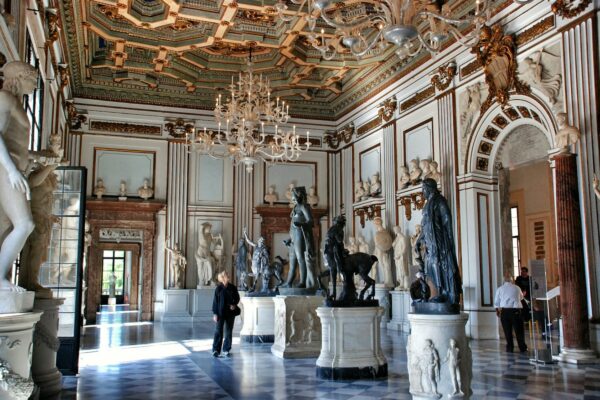
Flamboyant ceiling in Palazzo dei Conservatori
Below I will provide a number of tidbits to better organize your visit. In fact, to make the most of your time, it is best to prepare properly before you leave.
Fortunately, you will find everything here that is right for you. Let’s get going!
Schedules
I want to give you great news right away: the museums are open practically all year round!
In fact, you can plan your visit to the Capitoline Museums on the day of your choice, with the exception of only Christmas and May 1: these two days are the only ones when the site is closed.
The museums are always open from 9:30 a.m. to 7:30 p.m. with only a few very small exceptions.
In fact, on Dec. 24, Dec. 31 and Jan. 1, they observe reduced hours and specifically: on Christmas Eve and the last day of the year, the hours observed are from 9:30 a.m. to 2 p.m.
While on New Year’s Eve, the museum opens at 11 a.m. and closes at 8 p.m
If you are interested in our advice on the best time to visit the Capitoline Museums, find our dedicated article here.
Tickets, discounts and free admission
The cost to enter the Capitoline Museums is 20 euros, but you can add other services, such as audio or video guides, to the standard ticket.
The ticket can be purchased on site, at the museums’ ticket office, however it is highly recommended to buy online as only in this way will you have the chance to guarantee entry on the desired day and skip the long lines that are often created at the entrance to museums. Check out all the options you have thanks to the article on Capitoline Museums tickets.
However, remember that there are many categories of people who are allowed free or reduced price admission.
For example, people with disabilities and any accompanying person are entitled to free admission, as are residents of Rome and the Metropolitan City of Rome and young visitors under the age of 6.
To find out all the categories entitled to discounts and free admission read the article in which we explain who gets into the Capitoline Museums for free! Also remember that on the first Sundays of each month admission is free for everyone and that the museum sometimes organizes events to encourage visits.
One example is “A Night at the Museum,” an initiative thanks to which it is possible to access the Capitoline Museums in evening and night time slots for the symbolic price of 1 euro.
How to reach the museums
In addition, you should know that accessing museums is very easy. Being in the center of the city, there are in fact many ways to reach them.
First of all, if you are a tourist walking around Rome, it is easy for you to reach the Capitoline Museums on foot, since they are close to many other tourist attractions.
On the other hand, if you wish to get around by public transportation, you can rely on both the subway and the bus.
If you choose the rails you will have to move with line B and get off at the Colosseum stop, from here it is only a few minutes walk to the entrance of the Capitoline Museums in Capitol Square.
As for the bus, however, there are many lines that suit you. You can take the 40, 60, 63, 70, 81, 87, 190, 628 or the 8 streetcar line and get off at Piazza Venezia, which is only a two-minute walk from Piazza del Campidoglio. Uncovered tourist buses also pass through here!
If, on the other hand, you wish to move with your car, you should pay attention to the limited traffic zones (ZTL) in the center.
However, you will be able to count on many paid parking lots that also offer daily rates, some of which are less than a 15-minute walk from the Capitoline Museums.
If you want to know all the ways to get to the entrance of the Capitoline Museums, catch up with this article of ours.
On the other hand, if you are sure that you will move by car, you can check our article with the list of the best parking lots near the center of Rome.

Tickets for Capitoline Museums
Buy online. Choose the time you prefer. Visit the Capitoline Museums, the Ancient Agora, the Roman Agora, Hadrian’s Library and other archaeological sites.
You can cancel for free up to the day before your visit.
Suggested routes for the visit
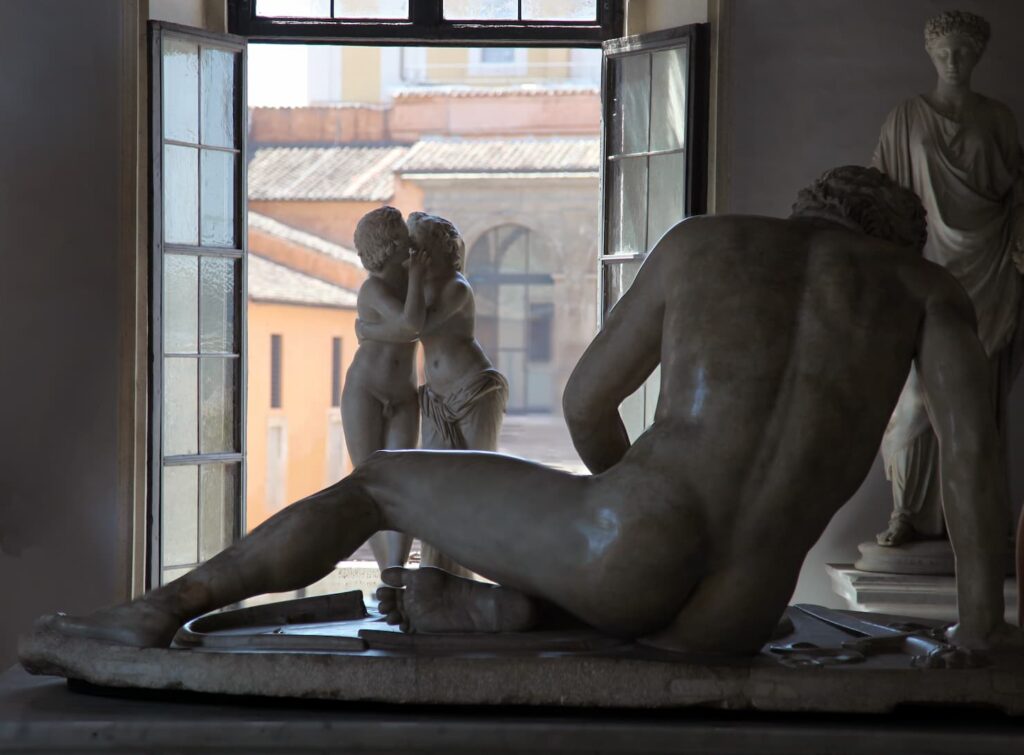
Rear of the Dying Galata with Cupid and Psyche in the background
As for the visit inside the museum, there are a few tricks to make the experience the best it can be.
The route suggested by the illustrated panels is the best to make sure you do not miss any work and go through all the rooms of the museum.
However, depending on your needs and interest, you are free to follow the order you prefer. The average recommended duration is about three hours: a time that allows you to observe all the wonders housed inside the Capitoline Museums, but without overstaying your welcome in each room.
If this is your goal, we recommend following the museum’s directions, taking advantage of the panels explaining the works.
By following the numbering indicated on them, you will be sure to complete the recommended route. Of course, you can also take more than the recommended three hours, since it is crucial to consider your interest in the various works and how much you want to entertain yourself at each of them.
It is possible to opt for a shorter visit if you are not interested in certain sections of the museum, or do not have the time for an exhaustive tour.
But if you have less than two hours to devote to this splendid museum, there are some works you just can’t miss!
Many you will find in the Exedra Hall, with its splendid bronze statues(Spinarius, Capitoline She-Wolf, Equestrian Statue of Marcus Aurelius), the Hall of Galata (or Gladiator), with the Dying Galata and Cupid and Psyche, the Capitoline Venus, and the last room of the Pinacoteca with Caravaggio ‘s masterpieces and Guercino‘s majestic altarpiece. Let’s take a deeper look at them.
The must-see works: what to see
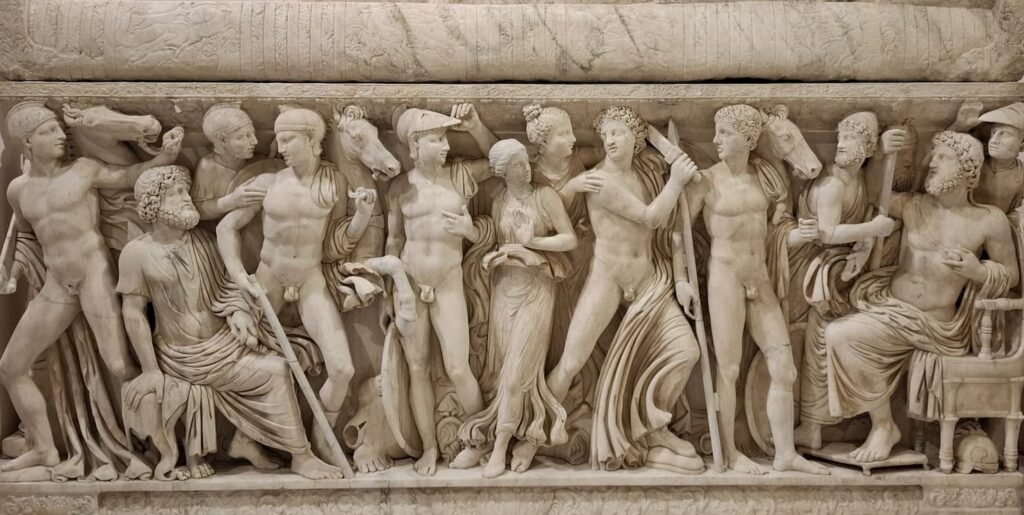
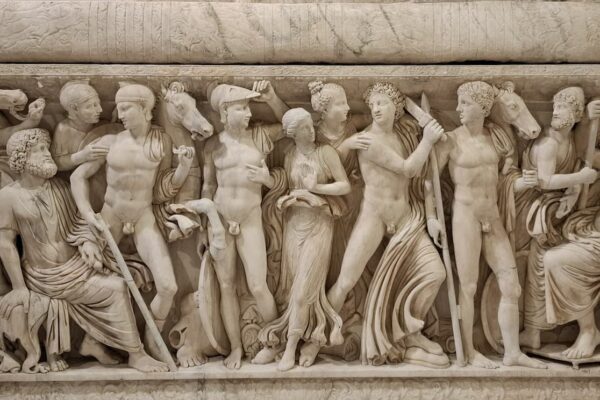
Detail of a sarcophagus in the Capitoline Museums
There are some works that, as I mentioned earlier, that are really im-per-di-bi-li!
We dedicated a special article to the 10 masterpieces of the Capitoline Museums, those precious works that attract hundreds of thousands of tourists from all over the world every year.
Here you will find a summary of the ones you cannot miss:
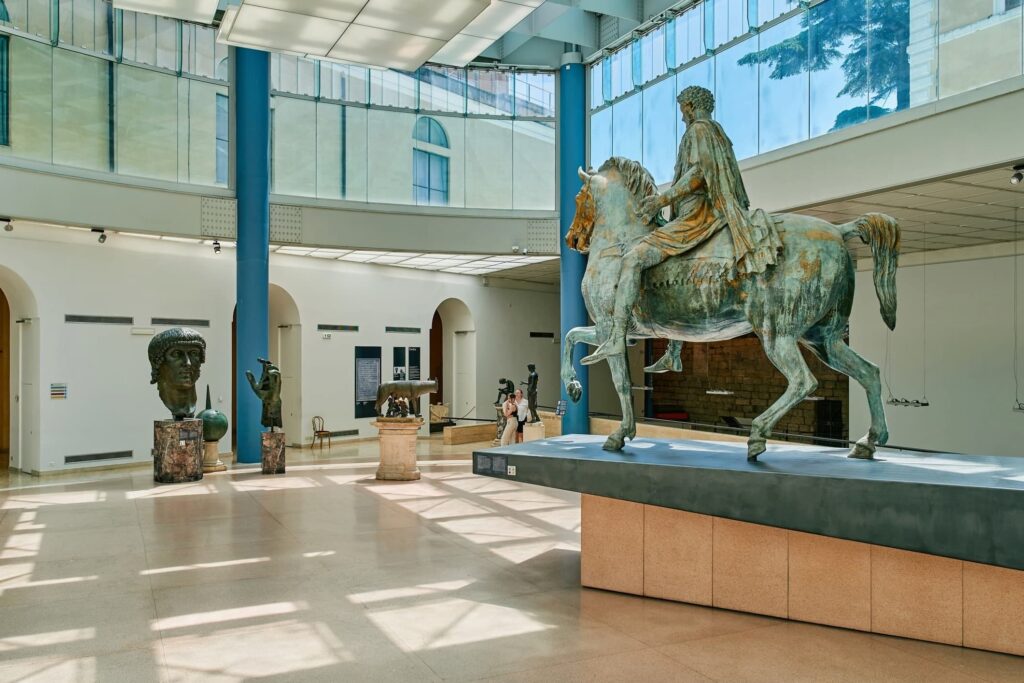
Equestrian statue of Marcus Aurelius
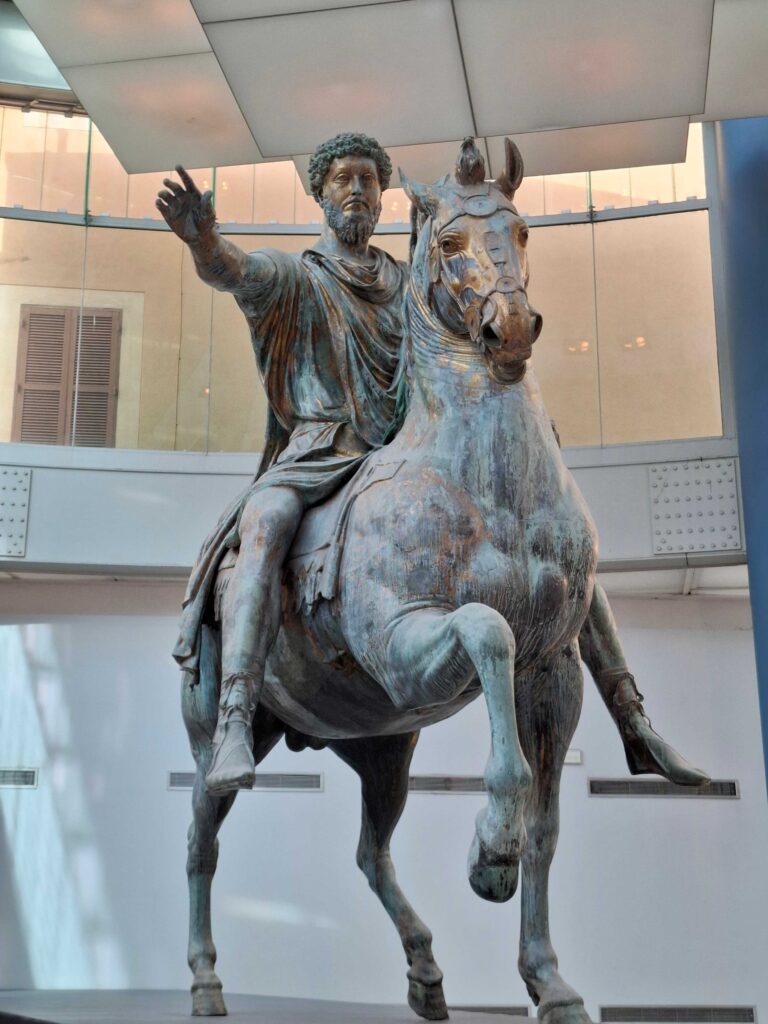
The work, erected between 176 A.D. and 180 A.D., is a gilded bronze representing Marcus Aurelius, the philosopher emperor.
It is a rare statue because it is the only equestrian one, of those from the imperial age, that has come down to us since it was not cast to recover its material.
In 1538 it was placed in Campidoglio Square: Michelangelo’s design was developed around it.
It was transported inside the museums to avoid leaving it exposed to the elements, as the statue was suffering damage. In its place, we find today a faithful copy of the original.
You can find it in the Sala Esedra inside the Palazzo dei Conservatori, along with other precious bronze statues.
Capitoline She-wolf
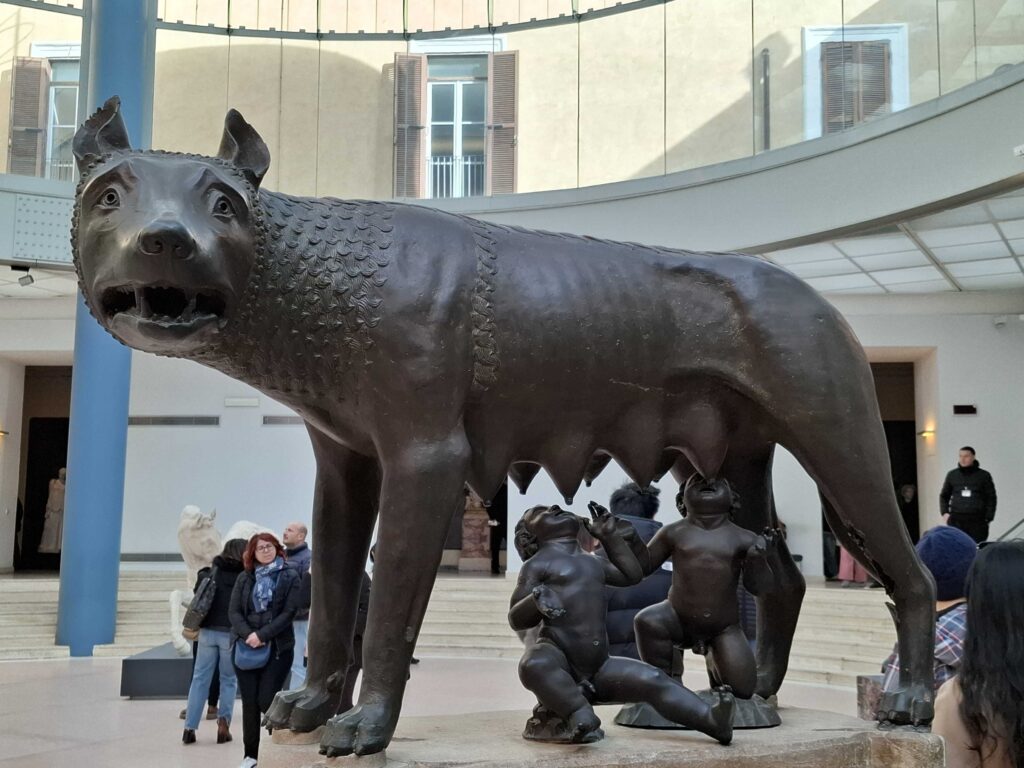
History: among the works donated by Pope Sixtus IV in 1471, the She-wolf has become a symbol of the city.
Of uncertain date, it is of Etruscan make , which is why the twins, Romulus and Remus, were actually added in the late 15th century by Antonio del Pollaiolo.
The Capitoline She-wolf is also kept in the striking Sala Esedra.
Dying Galata
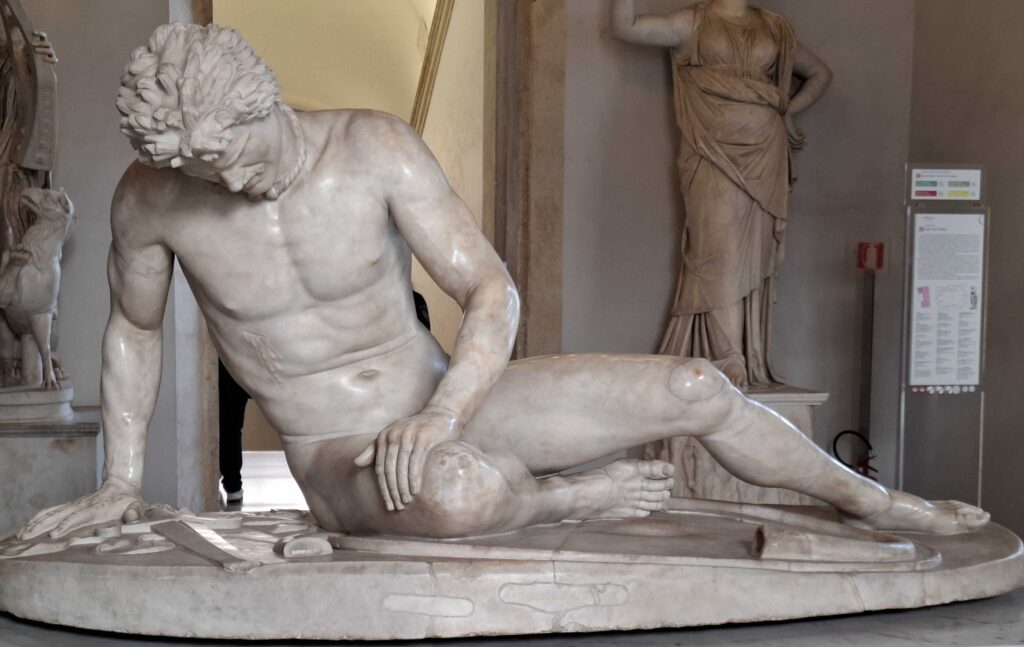
A copy of a Hellenistic work located on the temple at Pergamum, it was built to celebrate Attalus ‘ victories over the Celtic population.
The marvelous Dying Galata visible inside the Capitoline Museums is made of marble and was discovered in the early 17th century during excavations at Villa Ludovisi, although the original was, instead, made of bronze. The subject can be recognized by his shaggy mustache and hair, short sword, battle horn and, most importantly, the Celtic collar he wears.
The soldier is distressed and defeated, making no attempt to fight back, now mortally wounded.
It was among the masterpieces appreciated by Napoleon, who took it to France. The work reentered the collection of the Capitoline Museums only after the Congress of Vienna.
The Dying Galata is located in the Hall of the Galata (or Gladiator) on the second floor of the Palazzo Nuovo.
We also offer you an in-depth look at the Dying Galata of this work.
Capitoline Venus
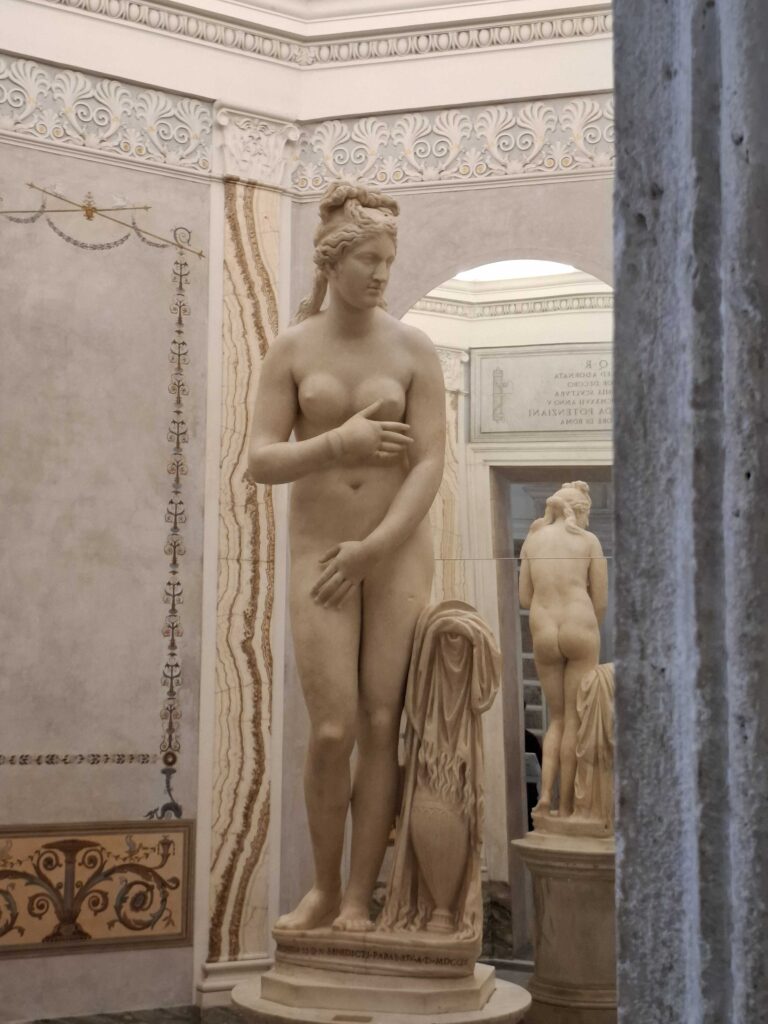
The Venus is also a Roman copy; the original was Hellenistic namelyPraxiteles ‘ Venus pudica .
The Capitoline one, dating from the 2nd century B.C., was found near the Basilica of San Vitale in the late 17th century and entered the museum in 1752 following a donation by Pope Benedict XIV.
It is nearly two meters tall and was so highly prized in antiquity that it became a model in its own right.
Think of more than a hundred reproductions of the Capitoline model.
Today it is placed in a splendid octagonal room: the mirror behind it offers the opportunity to admire every angle of this incredible statue, among the most valuable in the entire collection of the Capitoline Museums.
This room is better known as the Cabinet of Venus, a small octagonal room designed in the early 19th century on the second floor of the Palazzo Nuovo.
We have designed a dedicated in-depth study for this work as well.

Rear of the Dying Galata with Cupid and Psyche in the background
Cupid and Psyche
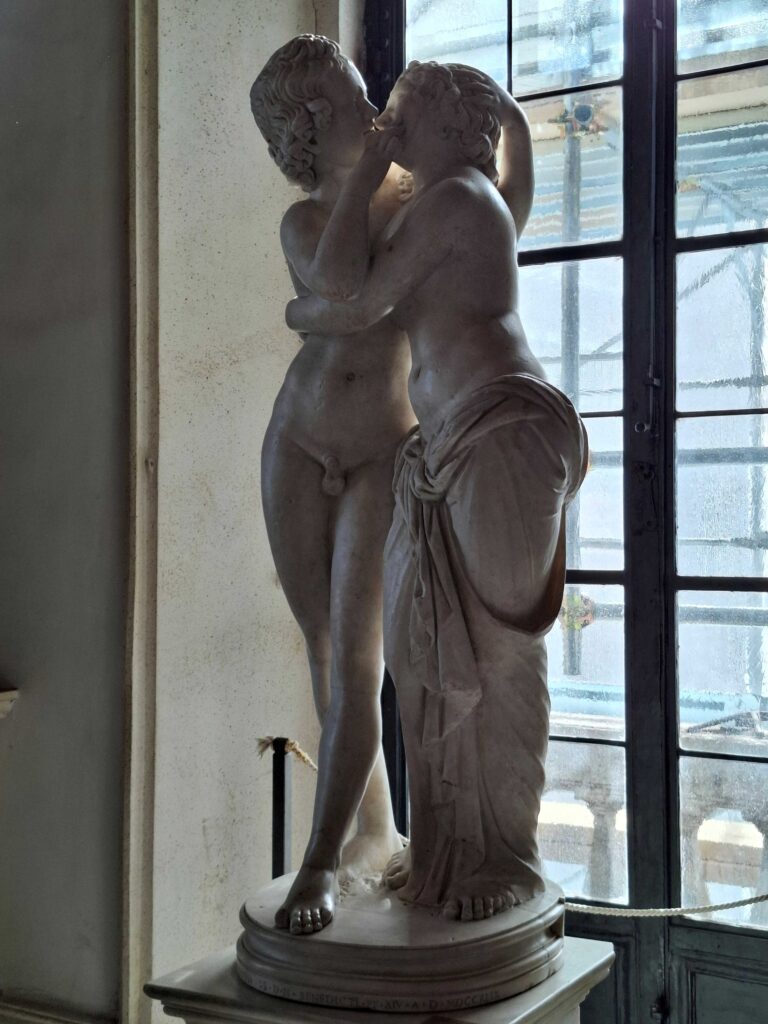
Housed in the same room as the Dying Galata, this statue shows us the two lovers made famous by Apuleius.
Just over three feet tall, it is a copy of a second-century B.C.E. original and is placed right in front of the room’s window.
Go look for it in the Hall of Galata (or Gladiator), on the second floor of the New Palace.
We could not pass up the opportunity to write a special in-depth article on Amore e Psiche.
Colossal head of Constantine
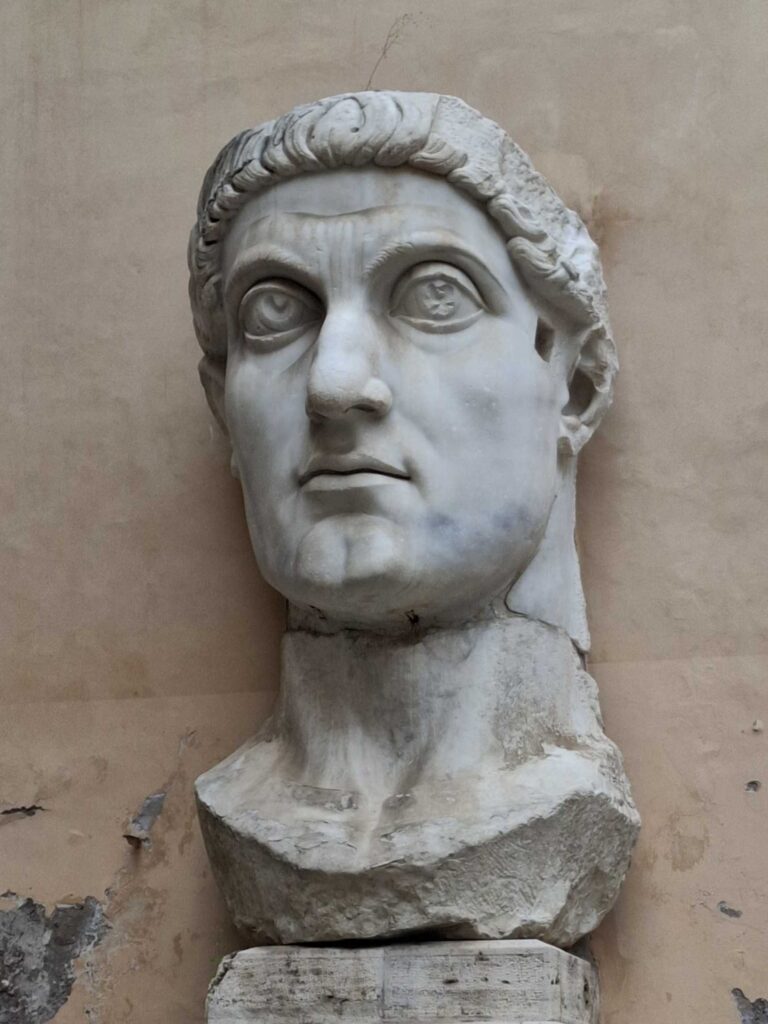
Of this impressive sculpture, only the head and some remains of the original have been found.
It is thought to have been a colossus of as much as 12 meters, composed of mixed materials.
The years to which the parts of this statue date are between 313 and 324 AD.
Just think that the head alone is a good two meters and sixty centimeters tall!
Currently you can admire it in the courtyard of the Palazzo dei Conservatori, from which tours usually start.
The two paintings by Caravaggio
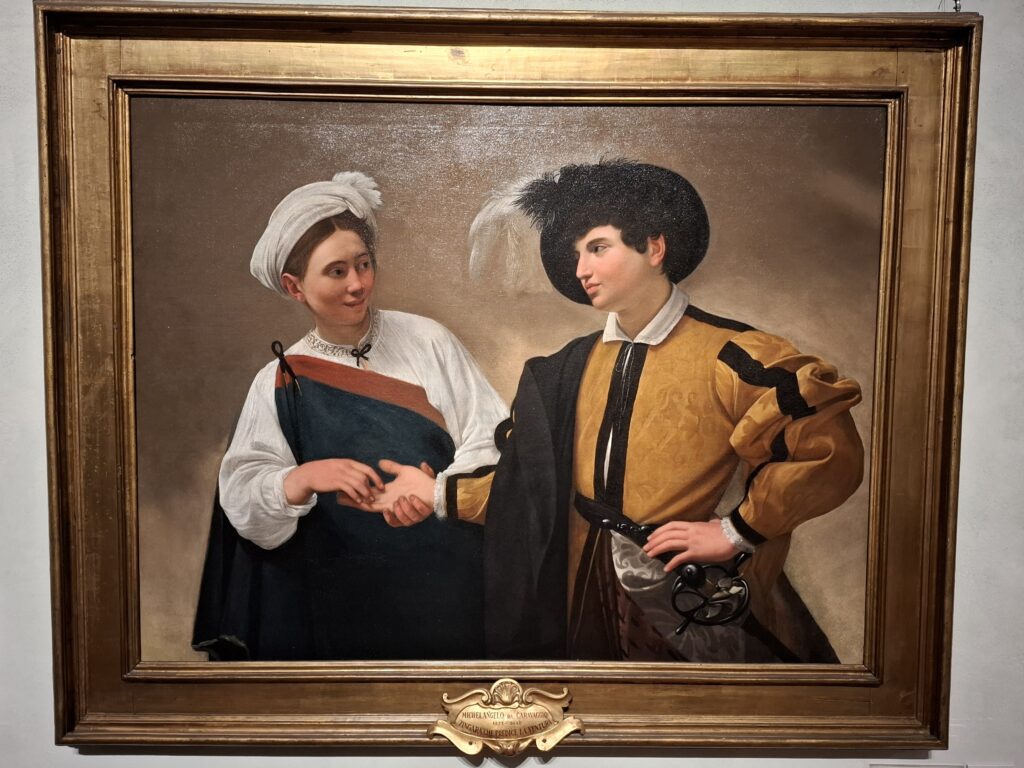

The works by Caravaggio contained within the Capitoline Museums are the Buona Ventura and the Saint John the Baptist. Housed within a splendid room along with other fine works of seventeenth-century Roman painting, these two paintings display the distinctive features that made the Lombard artist famous.
You can find them in the Sala di Santa Petronilla, inside the Pinacoteca Capitolina in the Palazzo dei Conservatori.
And if you wish, we have designed a rich in-depth study of precisely these two works.
Alternatively, you can check out this in-depth look at the Pinacoteca Capitolina.
The Burial of Saint Petronilla by Guercino
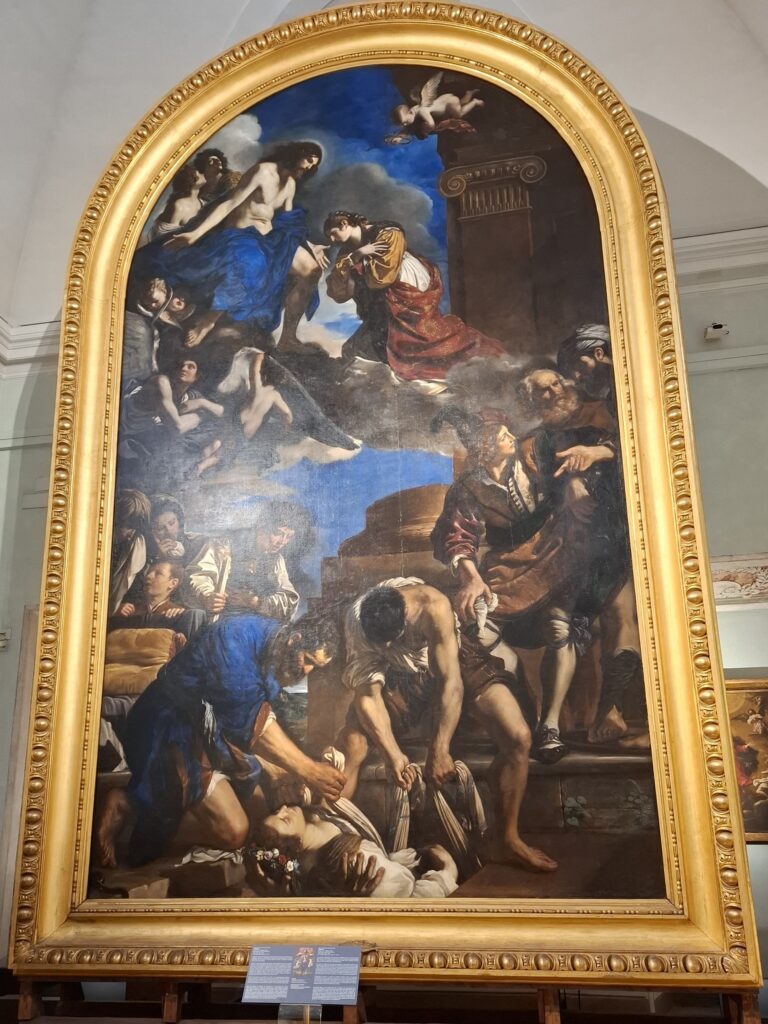
Guercino gave us a true masterpiece with this altarpiece painted between 1621 and 1623, during the pontificate of Gregory XV Ludovisi. It is from this work that the room in which it is housed takes its name.
Looking at it we can see Petronilla, one of the martyrs at the time of early Christianity.
The altarpiece can be hypothetically divided into two: in the lower part the saint is buried, while in the upper part she comes before Jesus Christ, elegantly dressed.
This work is also housed in the Pinacoteca Capitolina, more specifically in the Hall of Saint Petronilla, inside the Palazzo dei Conservatori.
The Spinario
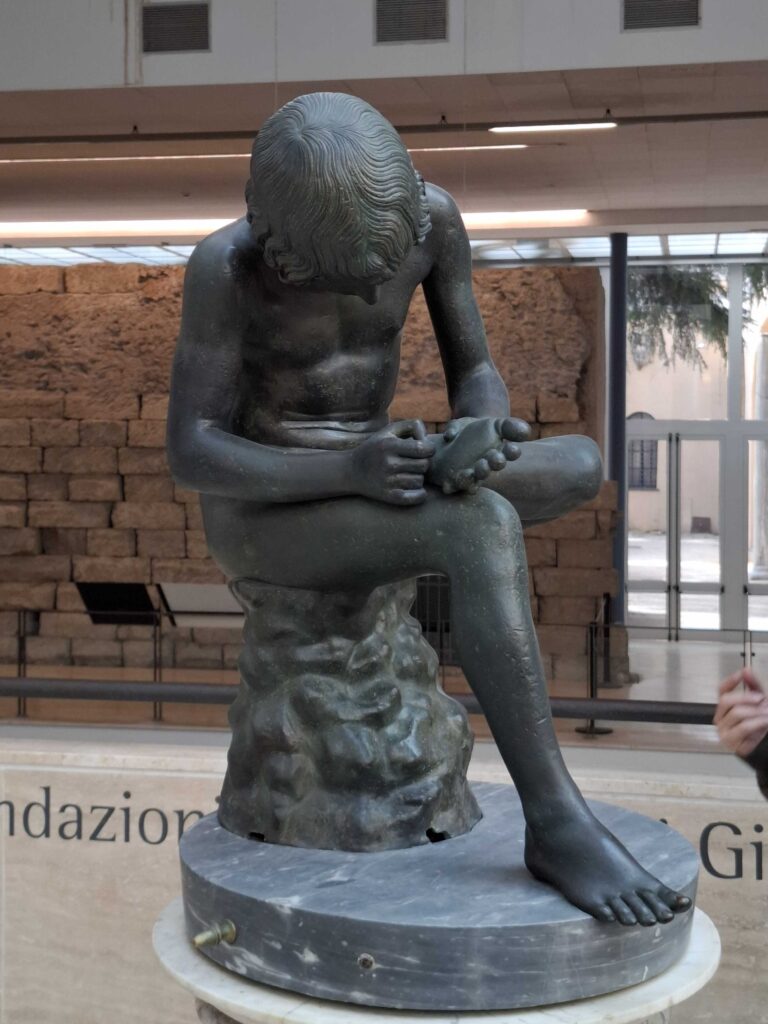
The Spinario is part of those bronze statues donated by Sixtus IV and depicts a young man trying to remove the thorn from his left foot.
This work is also Hellenistic and is estimated to date between the 3rd and 1st centuries BC.
Although it is a subject that boasts many depictions around the world, the one in the Capitoline Museums is thought to be one of the oldest, as it is mentioned in a writing dating back to the 12th century.
Like the other masterpieces that make up thecollection of bronze statues, it is housed in the Sala Esedra in the Palazzo dei Conservatori.
You can find our in-depth discussion of the Spinario here.
Temporary exhibitions and special events

Face of Agrippa Posthumus housed in the Capitoline Museums
The Capitoline Museums organize interesting cultural activities and events.
Although no new ones are momentarily scheduled, the calendar is updated daily, and there is no shortage of lectures and special guided tours.
In addition, as already mentioned, the museum occasionally organizes the “A Night at the Museum” event in which it is possible to access the Capitoline Museums during evening hours by paying the symbolic amount of one euro.
Most importantly, the museum’s management organizes temporary exhibitions that are always new!
Here is a brief overview of those currently on display:
Agrippa Iulius Caesar, the repudiated heir
november 29, 2024 – April 27, 2025 inside the Tapestry Room
Exhibition dedicated to Agrippa Postumo, heir of Augustus as well as indicated as imperial successor. The Sorgente Group Foundation allows us to observe his portrait, dialoguing ideologically with that of the Uffizi and that of the Capitoline Collections.
Following the story of Agrippa Postumo, this is the first time you will be able to see these three splendid marble sculptures together, all thanks to this exhibition.
Titian, Lotto, Crivelli and Guercino. Masterpieces from the Pinacoteca di Ancona
november 26, 2024 – March 30, 2025 inside the Palazzo dei Conservatori
Capitoline Museums and Ancona’s Pinacoteca Podesti together to preserve and admire in one place the marvelous works all with a religious character by Titian Vecellio, Ciccarello, Crivelli, Lotto and Guercino.
Five prestigious altarpieces and one tempera on panel from Ancona to Rome to show themselves in the splendid Capitoline rooms.
Colossal statue of Constantine
feb. 06, 2024 – Dec. 31, 2025 at the Garden of Villa Caffarelli
Starting from the found remains to a splendid copy built thanks to innovative techniques. Today you can observe with your own eyes theincredible colossus of more than 12 meters!
The Colors of Antiquity. Santarelli Marbles at the Capitoline Museums
april 13, 2022 – April 30, 2032 at Villa Caffarelli
The subject of this splendid exhibition is colored marbles, through their history from their origin to the 20th century.
660 polychrome marbles from the imperial age await you: two rooms, the first including 82 fragments from the Santarelli Foundation, the second containing early 19th-century finds from the same foundation, plus the collection of 288 tiles belonging to the Capitoline Museums.
In addition, a documentary will tell you about the history of these precious materials that influenced Rome in so many fields, even conditioning its geographical expansion.
The Farnese in Sixteenth-Century Rome. Origins and fortunes of a collection
february 11, 2025 – May 18, 2025 at Villa Caffarelli
The protagonist is Pope Paul III Farnese: it is a tribute to this very important personage through the Farnese collection.
It was he who initiated this scholarly collecting, which continued after his death through his grandchildren.
To understand the importance of this man, suffice it to say that he was responsible for the monumentalization of the Piazza del Campidoglio, since he entrusted the work to Michelangelo Buonarroti.
If you want to know all the events in detail, know that we have written an article about the Capitoline Museums exhibitions for you. Don’t miss it!
Useful tips for visiting

Reconstruction of the Colossal Statue of Constantine in the Gardens of Villa Caffarelli
Let me now give you some useful tips for planning your visit!
First of all, it is best to go in the early morning to museums so as to avoid crowds.
Remember, too, that by buying your ticket online you will also avoid the long lines!
Find all the options in our article dedicated to tickets.
If possible, try to visit the Capitoline Museums on a weekday, as they are less busy than on weekends.
And if getting up early is not your thing, then opt for late afternoon entry, when most visitors have already entered.
If you are looking for the right time, try to explore all the possibilities with this article of ours!
But remember The recommended duration for a full visit is about three hours: only then will you be able to complete the tour and see all the rooms!
Finally, also remember that you can purchase audio and video guides to enhance your experience, you can use the checkroom for free, and that the visit is mostly indoors, so opt for a lighter jacket in case you visit in the winter months.
Finally, avoid carrying large backpacks, which would not be accepted inside the museums anyway, but take only the essentials with you.
Tips on the outfit? We’ve thought about that, too. Check out our article on dress code.
Oh, and given the length of the view, I suggest you wear comfortable shoes and take advantage of Villa Caffarelli’s terrace for a refreshing moment!
Complete tour of the Capitoline Museums: frequently asked questions
Approximately three hours are recommended for visiting the Capitoline Museums: this is the estimated average time to be able to complete the entire tour and not leave out any room. However, depending on your needs and interests, you can opt for longer or shorter visits.
You can access the Capitoline Museums from Capitol Square: the tour starts from the Palazzo dei Conservatori. To enter you will need a ticket, which you can buy directly at the entrance to the museums, however I strongly recommend that you buy your ticket online so you can avoid the long lines often found at ticket offices.
Inside the Capitoline Museums are of various kinds the many works that can be observed: bronze statues, marble statues, paintings, altarpieces, tapestries, and more. Among the main works you cannot fail to see are the Dying Galata, Cupid and Psyche, the Capitoline Venus, the Equestrian Statue of Marcus Aurelius, the Capitoline She-Wolf, the Spinarius, paintings by Caravaggio, and the altarpiece by Guercino.
The Capitoline Museums are open every day of the year with the exception of Christmas and May 1. The hours observed are 9:30 a.m. to 7:30 p.m. except for Dec. 24 and Dec. 31, days on which it is open from 9:30 a.m. to 2 p.m., and Jan. 1, on which it is open from 11 a.m. to 8 p.m.
Conclusion

Giovanni Francesco Romanelli’s Saint Cecilia, kept in the Pinacoteca Capitolina
Here we come to the concluding part of our article. Congratulations! You finally got all the information you need to plan your visit to the Capitoline Museums flawlessly!
We looked together at the days and hours the museum is open and how to get there depending on the means of transportation you choose.
I then suggested how to explore the museums so you don’t miss anything and gave you some brief previews of what you’ll find, telling you some tidbits about the main works and exhibitions currently in the Capitoline Museums.
I’ve then embellished the guide with helpful tips on the ideal time in which to plan your visit, what clothing to choose, and much more.
But we recommend that you delve deeper with our articles devoted to the various topics covered. Finally, as always, I have answered the most frequently asked questions about the visit.
However, should you still have any curiosities to satisfy, please feel free to contact us by leaving a comment below.
And now that you have all the information, you just have to visit the Capitoline Museums! Book your ticket online now and discover the history and art of Rome like never before!
Capitoline Museums Tickets
Buy online. Choose the time you prefer. Visit the Capitoline Museums, the Ancient Agora, the Roman Agora, Hadrian’s Library and other archaeological sites.
You can cancel for free up to the day before your visit.